

Fundamentals of Fluid Flow in Porous Media
Chapter 2
Multi-phase Saturated Rock Properties:
Wettability: Contact Angle Hysteresis
According to the definition ‘hysteresis’ occurs when a measured variable depends on the direction of change of an independent variable. Some factors that may contribute to contact angle hysteresis are as follows:
- Surface roughness,
- Solid surface heterogeneity and differential adsorption of wettability aerating compounds,
- Surface immobility which prevents fluid motion that is necessary for the system to reach a three-phase contact point equilibrium. For example, a surfactant desorbing from the solid-liquid interface into the bulk liquid, and the solid film at the oil-water interface,
- Contamination,
- Components in different phases equilibrate among the phases. This can occur when surfactants have solubility in oil and water and adsorb at both interfaces.
- The solid phase contains soluble components and/or when oil contains compounds that adsorb onto solids. The adsorption of oil components is slow and the contact angle changes over hours or months; systems that are initially water-wet may change to oil-wet.
Figure 2‑38 shows the significant effect of rock-fluid-fluid interactions on the contact angle measurement.
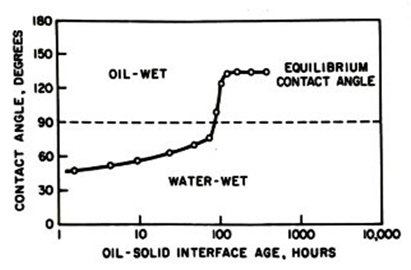
Figure 2-38: Rock-Fluid Interactions Effect on the Contact Angle
[fusion_builder_container hundred_percent=”yes” overflow=”visible” margin_top=”25″ margin_bottom=”” background_color=”rgba(255,255,255,0)”][fusion_builder_row][fusion_builder_column type=”1_1″ background_position=”left top” background_color=”” border_size=”” border_color=”” border_style=”solid” spacing=”yes” background_image=”” background_repeat=”no-repeat” padding=”” margin_top=”0px” margin_bottom=”0px” class=”” id=”” animation_type=”” animation_speed=”0.3″ animation_direction=”left” hide_on_mobile=”no” center_content=”no” min_height=”none”][fusion_separator /]
[/fusion_builder_column][/fusion_builder_row][/fusion_builder_container][fusion_builder_container hundred_percent=”yes” overflow=”visible”][fusion_builder_row][fusion_builder_column type=”1_2″ last=”no”]
[/fusion_builder_column]
[fusion_builder_column type=”1_2″ last=”yes”]
LABORATORY DETERMINATION OF WETTABILITY >>
[/fusion_builder_column]
[fusion_builder_column type=”1_1″ background_position=”left top” background_color=”” border_size=”” border_color=”” border_style=”solid” spacing=”yes” background_image=”” background_repeat=”no-repeat” padding=”” margin_top=”0px” margin_bottom=”0px” class=”” id=”” animation_type=”” animation_speed=”0.3″ animation_direction=”left” hide_on_mobile=”no” center_content=”no” min_height=”none”][fusion_separator top=”35″/]
References
[/fusion_builder_column][fusion_builder_column type=”1_1″ background_position=”left top” background_color=”” border_size=”” border_color=”” border_style=”solid” spacing=”yes” background_image=”” background_repeat=”no-repeat” padding=”” margin_top=”0px” margin_bottom=”0px” class=”” id=”” animation_type=”” animation_speed=”0.3″ animation_direction=”left” hide_on_mobile=”no” center_content=”no” min_height=”none”][1]
Questions?
If you have any questions at all, please feel free to ask PERM! We are here to help the community.[/fusion_builder_column][/fusion_builder_row][/fusion_builder_container]