

Fundamentals of Fluid Flow in Porous Media
Chapter 2
Multi-phase Saturated Rock Properties:
Capillary Pressure Hysteresis: Contact Angle Hysteresis During Displacement
According to the definition ‘hysteresis’ occurs when a measured variable depends on the direction of change of an independent variable. According to eq.(2‑78) contact angle hysteresis will cause hysteresis in the capillary pressure. Consider a capillary tube containing two immiscible fluids (Figure 2‑62):
Case 1: Displacement by drainage
θR = receding contact angle (i.e. wetting phase receding)
Occurs when the non-wetting phase displaces the wetting phase by increasing Pnw.
( Pc )Drainage = ( 2σcosθR ) / r
Case 2: Equilibrium
θE = equilibrium or static contact angle
Pc = ( 2σcosθE ) / r
Case 3: Displacement by imbibition
θA = advancing contact angle (i.e. Wetting phase is advancing)
Occurs when the non-wetting phase is displaced by the wetting phase by a decrease Pnw
( Pc)Imbibition = ( 2σcosθA ) / r
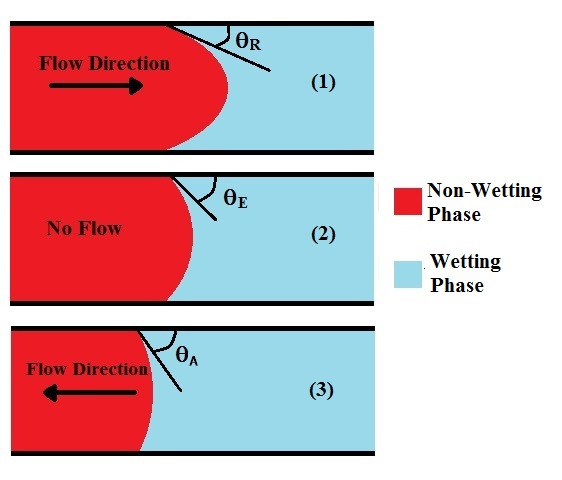
Figure 2-62: Contact Angle Hysteresis during the Displacement
In general it can be stated that:

Therefore at the same saturation:

Figure 2‑63 shows dynamic contact angle behavior
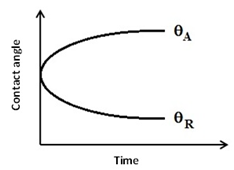
Figure 2-63: Dynamic Contact Angle Behavior
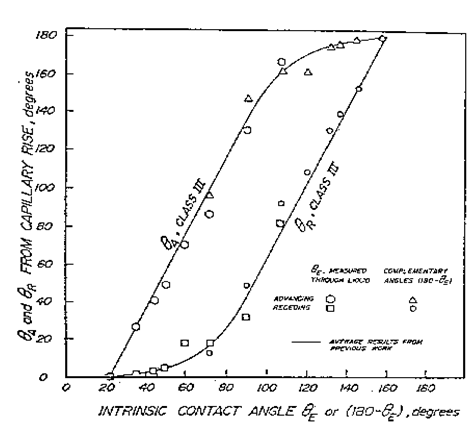
Figure 2-64: Static Values of Advancing and Receding Contact Angles at Rough Surfaces versus Values at Smooth Surfaces (where θE refers to smooth surface measurements)
[fusion_builder_container hundred_percent=”yes” overflow=”visible” margin_top=”25″ margin_bottom=”” background_color=”rgba(255,255,255,0)”][fusion_builder_row][fusion_builder_column type=”1_1″ background_position=”left top” background_color=”” border_size=”” border_color=”” border_style=”solid” spacing=”yes” background_image=”” background_repeat=”no-repeat” padding=”” margin_top=”0px” margin_bottom=”0px” class=”” id=”” animation_type=”” animation_speed=”0.3″ animation_direction=”left” hide_on_mobile=”no” center_content=”no” min_height=”none”][fusion_separator /]
[/fusion_builder_column][/fusion_builder_row][/fusion_builder_container][fusion_builder_container hundred_percent=”yes” overflow=”visible”][fusion_builder_row][fusion_builder_column type=”1_2″ last=”no”]
<< CAPILLARY PRESSURE HYSTERESIS
[/fusion_builder_column]
[fusion_builder_column type=”1_2″ last=”yes”]
[/fusion_builder_column]
[fusion_builder_column type=”1_1″ background_position=”left top” background_color=”” border_size=”” border_color=”” border_style=”solid” spacing=”yes” background_image=”” background_repeat=”no-repeat” padding=”” margin_top=”0px” margin_bottom=”0px” class=”” id=”” animation_type=”” animation_speed=”0.3″ animation_direction=”left” hide_on_mobile=”no” center_content=”no” min_height=”none”][fusion_separator top=”35″/]
References
[/fusion_builder_column][fusion_builder_column type=”1_1″ background_position=”left top” background_color=”” border_size=”” border_color=”” border_style=”solid” spacing=”yes” background_image=”” background_repeat=”no-repeat” padding=”” margin_top=”0px” margin_bottom=”0px” class=”” id=”” animation_type=”” animation_speed=”0.3″ animation_direction=”left” hide_on_mobile=”no” center_content=”no” min_height=”none”][1]
Questions?
If you have any questions at all, please feel free to ask PERM! We are here to help the community.[/fusion_builder_column][/fusion_builder_row][/fusion_builder_container]